Types of File Cabinets: Which Style Fits Your Home?
The main types of file cabinets are vertical, lateral and mobile pedestals, plus smaller specialty options. Vertical models save floor width and hold letter or legal folders, lateral models give you a wide surface and easier side-to-side sorting, and mobile pedestals roll where you need them.
On this page (12 sections)
- What are the main types of file cabinets?
- How does a vertical file cabinet work?
- When should you choose a lateral file cabinet?
- Are mobile pedestals the best choice for small rooms?
- What about open-shelf and card file options?
- How do you match a cabinet style to your room?
- How many drawers do you need for home papers?
- Which cabinet type suits letter and legal files?
- What locks and safety features matter at home?
- How should you set up and care for a new file cabinet?
- Which type of file cabinet should you buy?
- How we scored these cabinets
The main types of file cabinets are vertical, lateral and mobile pedestals, plus smaller specialty styles for light storage. Each one changes how much floor space you give up and how easily you reach your papers.
Your choice comes down to three things: the wall or floor space you have, whether your papers are letter or legal size, and how often you open the drawers. A narrow vertical cabinet and a wide lateral cabinet can hold similar amounts of paper but feel very different in a small room.
This guide walks through each type in plain terms, names who each one suits, and gives you a firm rule at the end of every section.
What are the main types of file cabinets?
The main types of file cabinets are vertical, lateral and mobile pedestal models, with open-shelf and card files as smaller specialty options. Vertical cabinets stand tall and narrow, lateral cabinets run wide and low, and pedestals roll on casters so you can move them to the work.
Each type is built around a different trade-off. Vertical models win on floor width.
Lateral models win on top surface and side-to-side sorting. Mobile pedestals win on flexibility, since they follow you around the room.
Most home buyers end up choosing between a vertical and a lateral cabinet. Pedestals suit desks and shared rooms, while open shelves and card files handle small jobs like mail or index cards.
- Vertical: tall, narrow cabinet with drawers that pull toward you.
- Lateral: wide, shallow cabinet with drawers that pull out sideways to load.
- Mobile pedestal: compact cabinet on casters, often under-desk height.
- Open-shelf file: no drawers, folders sit on visible shelves.
- Card file: small drawers for index cards or small reference items.
Start with your paper size and floor width. If you have a narrow wall and mixed letter and legal files, a vertical cabinet sold for both sizes is the simplest fit.
If you want a wide top for a printer or plant, look at lateral models first.
How does a vertical file cabinet work?
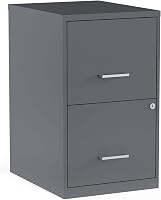
A vertical file cabinet is a tall, narrow cabinet with drawers that pull toward you, holding folders front to back. It stacks paper in depth rather than across width, which is why two drawers can fit in about 14 inches of floor space.
That narrow footprint is the whole point. In a bedroom, closet or narrow home office, a vertical cabinet can tuck against a wall where a wide lateral would block a door or walkway.
The Staples 2-Drawer Vertical Letter/Legal File Cabinet measures 18.9 inches deep, 14.3 inches wide and 24.1 inches high.
Vertical drawers hold hanging folders on rails. The Staples model has high-side drawers for letter-size hanging files and takes legal files too.
Its built-in key lock adds privacy in a shared room, and Staples backs it with a 7-year warranty.
The trade-off is reach. Deep drawers mean you flip through folders from front to back, and papers at the back sit furthest from your hand.
A vertical cabinet also needs clear space in front so the drawers can open fully.
Pick a vertical cabinet if your floor width is tight and you file in batches. Its narrow shape gives you the most paper storage per inch of wall.
If you sort papers one at a time while standing, a lateral cabinet's wide drawers will feel easier.
When should you choose a lateral file cabinet?
Choose a lateral file cabinet when you want a wide top surface and drawers you can load from the side. The wide drawers let you see several folders at once, which speeds up sorting and refiling.
The VASAGLE 2-Drawer Lateral File Cabinet measures 15.7 inches deep, 34.1 inches wide and 29.5 inches high, so it runs wide and low. Each drawer holds two rows of legal-size folders.
Its hanging rails adjust for A4, letter-size and legal-size folders, which helps if your paperwork is mixed. An interlocking slide design keeps one drawer shut while the other is open, which reduces tipping risk.
The top works as a printer stand, and the rustic brown finish looks more like furniture than a plain metal box.
The cost is width and weight. At 34.1 inches and 73.7 pounds, it needs a long wall, a helper for delivery and the included anti-tip kit to secure it to the wall.
Pick a lateral cabinet if you have a wide wall and want the top to work for you. If your only free space is a narrow gap, go back to a vertical model.
Are mobile pedestals the best choice for small rooms?
Mobile pedestals are the best type for shared rooms and desks that need storage on demand. They roll on casters, so you can push one under a desk or pull it beside a table when it's time to file.
The Lorell Mobile Pedestal File with Lock measures 16.54 inches deep, 28.35 inches wide and 6.5 inches high, so it sits low. Four dual-wheel casters make it easy to move.
It's built for letter-size hanging folders, which are sold separately. A sliding cover, a piano-hinge top and a key lock secure the contents.
The units are keyed alike, so one key pattern covers several cabinets. A bottom shelf adds open storage under the covered section.
The trade-off is capacity. A 6.5-inch cabinet holds far less paper than a full vertical or lateral model, so it suits active files you reach for daily, not years of archived records.
Its small size also makes it easy to park out of the way. Roll it into a closet when guests arrive, then pull it back to your desk when you need it.
Pick a mobile pedestal if you file daily and want the cabinet to follow you. It suits a desk, a kitchen command center or a room that doubles as an office, and a full-size cabinet elsewhere can hold the long-term archive.
What about open-shelf and card file options?
Open-shelf and card files handle small, visible storage jobs rather than large paper archives. They skip the drawer box, so they cost less and take up less depth, but they also expose your papers to dust and view.
An open-shelf file holds folders or bins on visible shelves. It works well for mail, catalogs or project folders you grab all day.
The downside is appearance: open shelves look busy in a living room, and there's no lock or cover.
A card file is a small cabinet with shallow drawers for index cards, receipts or small reference items. It's the right tool for a recipe box, a contact card system or a set of small parts.
It won't hold letter-size hanging folders.
Both types suit a desk top or a shelf rather than a floor. They're often used beside a main cabinet, not instead of one.
Think of them as the small bins that keep daily paper from piling up on the counter.
Pick an open-shelf or card file only for small, active storage. If you need to protect tax records, medical papers or a year of files, choose a closed cabinet with drawers.
Save the open options for the papers you want to see and reach every day.
How do you match a cabinet style to your room?
Match the cabinet style to your wall length, door swing and the room's other furniture before you compare drawer counts. A cabinet that fits your papers but blocks a closet door will annoy you every day.
Start with the wall. A vertical cabinet needs only about 14 to 19 inches of width, while a lateral cabinet often needs 30 inches or more, so measure the clear space and leave room for drawers to open.
Next, check the floor. The VASAGLE lateral weighs 73.7 pounds empty, so set it down near its final spot, while a vertical at about 20.5 pounds is easier to move alone.
Then think about the room. A bedroom suits a cabinet that looks tidy when closed, a basement office can take a plain metal vertical, and a living-room corner suits a furniture-style lateral.
If you keep both letter and legal files, choose a cabinet rated for both. Our guide to the letter vs legal file cabinet choice explains how drawer depth differs.
How many drawers do you need for home papers?
The number of drawers you need depends on how much paper you keep and how often you add to it. Two drawers suit most home paper piles, and a third helps when you file for a family or a small business.
A typical archive of bills, tax records, medical papers and manuals often fits in two drawers. A family with school papers and household records may fill three.
Drawer count also changes height. A two-drawer vertical is short enough to sit under a window, while a three-drawer model needs more wall height.
Two drawers split neatly into active files on top and archive below. Three let you give household, financial and personal papers their own zones, and our post on 2 or 3 drawer file cabinets compares the trade-offs in more detail.
Pick two drawers for a modest home archive and three for a family or home business. If you're unsure, count your current folders and add a third for growth.
Which cabinet type suits letter and legal files?
A cabinet suits letter and legal files when its drawers are rated for both sizes, not just one. Legal folders need more depth than letter folders, so a cabinet sold only for letter files won't hold them properly.
The Staples vertical cabinet is rated for both. Its high-side drawers take letter-size hanging files and its depth leaves room for legal folders, which helps when tax papers and contracts arrive in different sizes.
The VASAGLE lateral cabinet goes further with adjustable hanging rails in each drawer. You can set them for A4, letter-size or legal-size folders and change the setup later.
The Lorell pedestal is designed for letter-size hanging folders only. That's fine for everyday bills and letters, but legal documents won't hang properly inside it.
Mixing sizes in one drawer can waste space or let folders slide. A cabinet rated for both keeps every folder on its rails.
Our how to set up a file cabinet guide shows how to load the drawers so both sizes stay upright.
Buy a dual-size cabinet if your papers are mixed, and a letter-only cabinet if they aren't. Legal-only files are rare at home, so dual-size is the safer default.
What locks and safety features matter at home?
The safety features that matter most are a working lock for private papers and an anti-tip measure for tall or heavy cabinets. A lock slows casual access, and securing the cabinet to the wall helps prevent tipping when a drawer is open.
The Staples vertical has a built-in key lock. The Lorell pedestal uses a key lock and its units are keyed alike.
The VASAGLE lateral has an interlocking drawer design and ships with an anti-tip kit.
None of these locks makes a cabinet fireproof or waterproof. A lock only keeps honest people out and stops casual snooping.
If you keep irreplaceable documents, store copies in a separate safe place too.
For tipping, tall and heavy cabinets are the main concern. The VASAGLE lateral includes an anti-tip kit and VASAGLE advises securing it to the wall.
A full drawer pulls the cabinet's weight forward, so anchor tall vertical models as well.
Lock your most private papers and anchor any cabinet taller than your waist. A key lock plus a wall anchor covers the two real home risks: snooping and tipping.
Skip both only if the cabinet sits in a locked room and stays low.
How should you set up and care for a new file cabinet?
Set up a new cabinet by placing it on level ground, anchoring it if it's tall or heavy, and loading the bottom drawers first. That order keeps the cabinet stable and makes your first filing session easier.
Start with the spot. Clear the floor, check the wall for outlets and vents, and leave the drawer clearance you measured earlier.
For a heavy lateral cabinet, get a helper and slide it on cardboard rather than dragging it.
The Staples vertical and VASAGLE lateral both include easy-to-follow instructions and numbered parts, and the VASAGLE kit adds an anti-tip kit. Build on a flat surface and keep the hardware bag in one place.
Secure tall cabinets to a wall stud where possible. Then load hanging folders from the bottom drawer up so the weight stays low, leaving a little slack so folders slide instead of jamming.
For care, wipe painted or steel surfaces with a damp cloth and dry them. Keep the drawer slides free of paper scraps and check the lock key now and then.
When you're ready to fill it, our how to organize paperwork at home guide walks through sorting, labeling and keeping the system going.
Which type of file cabinet should you buy?
Buy a vertical cabinet for narrow floor space, a lateral cabinet for a wide wall and a usable top, or a mobile pedestal for a desk that needs rolling storage. Those three types cover nearly every home paper problem.
For most homes with a tight spot, the Staples 2-Drawer Vertical Letter/Legal File Cabinet is the best overall pick. It is 14.3 inches wide, takes both letter and legal files, and has a key lock for private papers.
Choose the VASAGLE 2-Drawer Lateral File Cabinet if you have a longer wall and want the top to work as a printer stand. Its adjustable rails handle A4, letter and legal folders, and its interlocking drawers add a safety step.
Pick the Lorell Mobile Pedestal File with Lock when you file daily at a desk and want the cabinet to roll with you. It runs on four casters and locks with a key, but it holds letter-size folders only.
Whichever you choose, measure the wall, the drawer clearance and your paper size first. Our how to set up a file cabinet guide takes you from empty drawers to a labeled, working system.
How we scored these cabinets
Our score weighs specs, features and how well each cabinet fits a home buyer's needs against what you're shopping for. A narrow cabinet in a tight room earns points for fit, while a wide cabinet in a large office does the same.
We looked at drawer count, paper sizes supported, locks, safety features, footprint and weight. We also weighed how easily each type moves and assembles.
Scores spread realistically: no cabinet wins on every point, and a lower score often means a narrower fit for a specific room.
None of these cabinets suits every room. The best type for you is the one that fits your wall, your papers and your daily routine.
Compare the three picks above against those three needs, then choose the style that makes filing easy enough to keep up with.
Frequently asked questions
Is a vertical or lateral file cabinet better for home use?
Pick vertical when floor width is tight, since a two-drawer model can be about 14 inches wide. Pick lateral when you want a wide top and easier side-to-side sorting.
Home offices often have room for either, so measure first.
What size file cabinet holds letter and legal files?
Look for drawers labeled for letter and legal hanging files. A legal folder needs more depth than a letter folder, so a cabinet sold for both sizes is the safe choice if your papers are mixed.
Check the drawer's hanging rails before you buy.
Can a file cabinet fit under a desk?
Some mobile pedestals do, including compact models on casters. Measure the clear height under your desk and compare it with the cabinet height before buying.
A full-size vertical or lateral cabinet is too tall to slide under most desks.
Do I need a locking file cabinet at home?
A lock helps if you keep tax records, medical papers or anything private in a shared room. Many vertical and pedestal cabinets include a key lock.
A lock slows casual access, but it does not make a cabinet fireproof.
How much weight can a file cabinet drawer hold?
It depends on the drawer slides and the cabinet's build. Light-duty home cabinets suit everyday paper storage, while heavy loads need sturdier slides.
Spread weight evenly and avoid overfilling a drawer past its rails.